You’ve probably noticed that many of the artworks in our digital gallery are dedicated to India. And this is not surprising, because the classical heritage and folklore of this country leave no one indifferent, not to mention the fact that meditation, as a way to achieve the creative result that our artists declare, also comes from there.
At the same time, the range of themes, genres, styles, and artistic movements represented on the website is remarkably broad. Artists from 26 countries across different continents are currently featured here, and despite the shared interest in Indian themes, each of them has contributed a unique touch from their own national cultural heritage, not to mention the distinctive charm of their individual creative personalities. As you journey from page to page, from artwork to artwork, it is as if you were gazing at the Earth from space, gently touching one geographical point after another. Each destination opens a window into the positive energy that has been nurtured and preserved there through the centuries.
This is precisely why it is difficult to describe the overall impression of Sahaja art in conventional art-historical terms. Instead, one is tempted to speak of sparkling, joyful bubbles that seem to fill the viewer’s or listener’s entire being while experiencing these works. Yes, I am referring to that very feeling which has become a rare visitor in today’s world of seemingly betrayed dreams, perpetually dissatisfied materialism, and an almost universal inclination toward pessimism. It is the joy of being. And it is precisely this joy that appears to permeate every single work.
How is this possible? Can meditation and creativity truly coexist in the same moment? What distinguishes Sahaja art from the immense flow of artistic works being created around the world today? In this article, we will attempt to answer these questions.
Let us explore them together
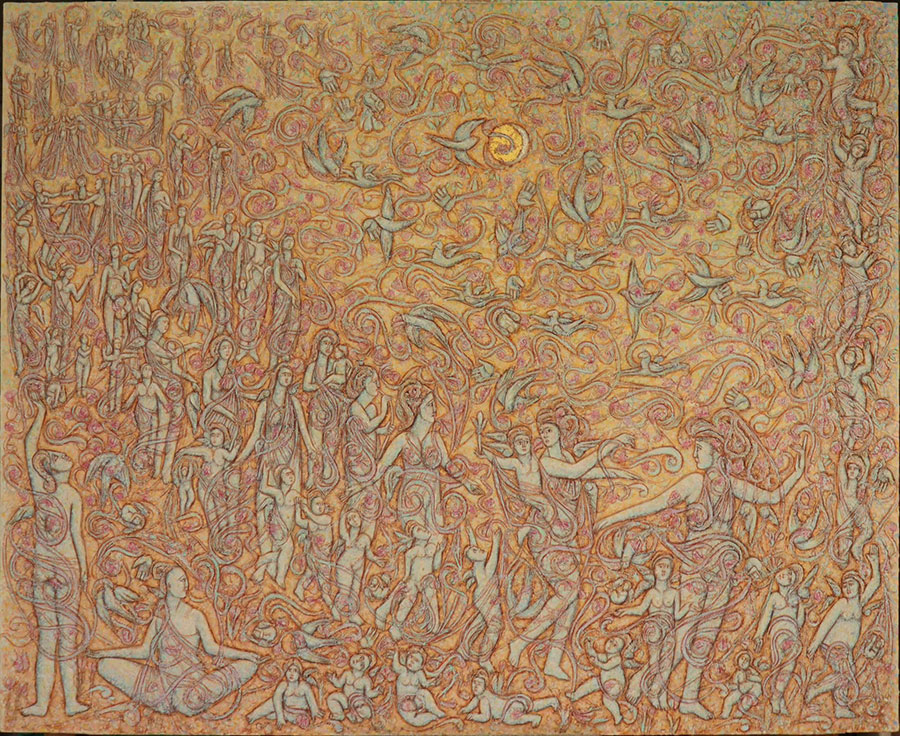
COLIN HEINSEN, UK, 2023, The Procession of the Golden Age
The Far Side of the Moon: What Makes a Sahaja Artist Different
Speaking about Sahaja culture, Shri Mataji, the founder of Sahaja Yoga, once compared it to the Moon, which has two sides: one visible from Earth and familiar to us all, and another hidden from human sight. The same metaphor can be applied to Sahaja art, for it is inseparable from the wider realm of culture to which it belongs.
Let us begin with the first, outward side of Sahaja art. In many respects, it does not differ from art in general. As elsewhere, it is governed by the universal laws of space, time, and light. It encompasses a wide variety of artistic movements, genres, techniques, and themes. Its creators and performers are often highly trained professionals, respected by their peers and appreciated by a loyal audience of their own.
At the same time, the inner aspect of Sahaja art remains unseen by the viewer. Yet it is the defining element, worthy of deeper exploration, so that the feelings that arise in our hearts when we behold its creations can be experienced with greater awareness and understanding.
If its essence were to be expressed in three brief statements, they would be as follows:
- These works are created by artists who have attained Self-realization through Sahaja Yoga
- While creating, they meditate and remain in the state of being a conduit of creative energy
- Their creations are infused with the vibrations of joy
All these characteristics are readily perceived by those who practice the method of collective Self-realization. An ordinary viewer, on the other hand, receives not only aesthetic enjoyment but also feeling of serene joy. Incidentally, there are several ways to keep this feeling with you. You may purchase a painting from our website or listen to the music featured there — which is worthwhile in itself. Or you may choose to receive Self-realization at any of the venues where Sahaja Yoga is taught, always free of charge.
Let us now examine each element of the definition of Sahaja art, for each of them reveals a hidden layer of meaning within every work presented on our website.
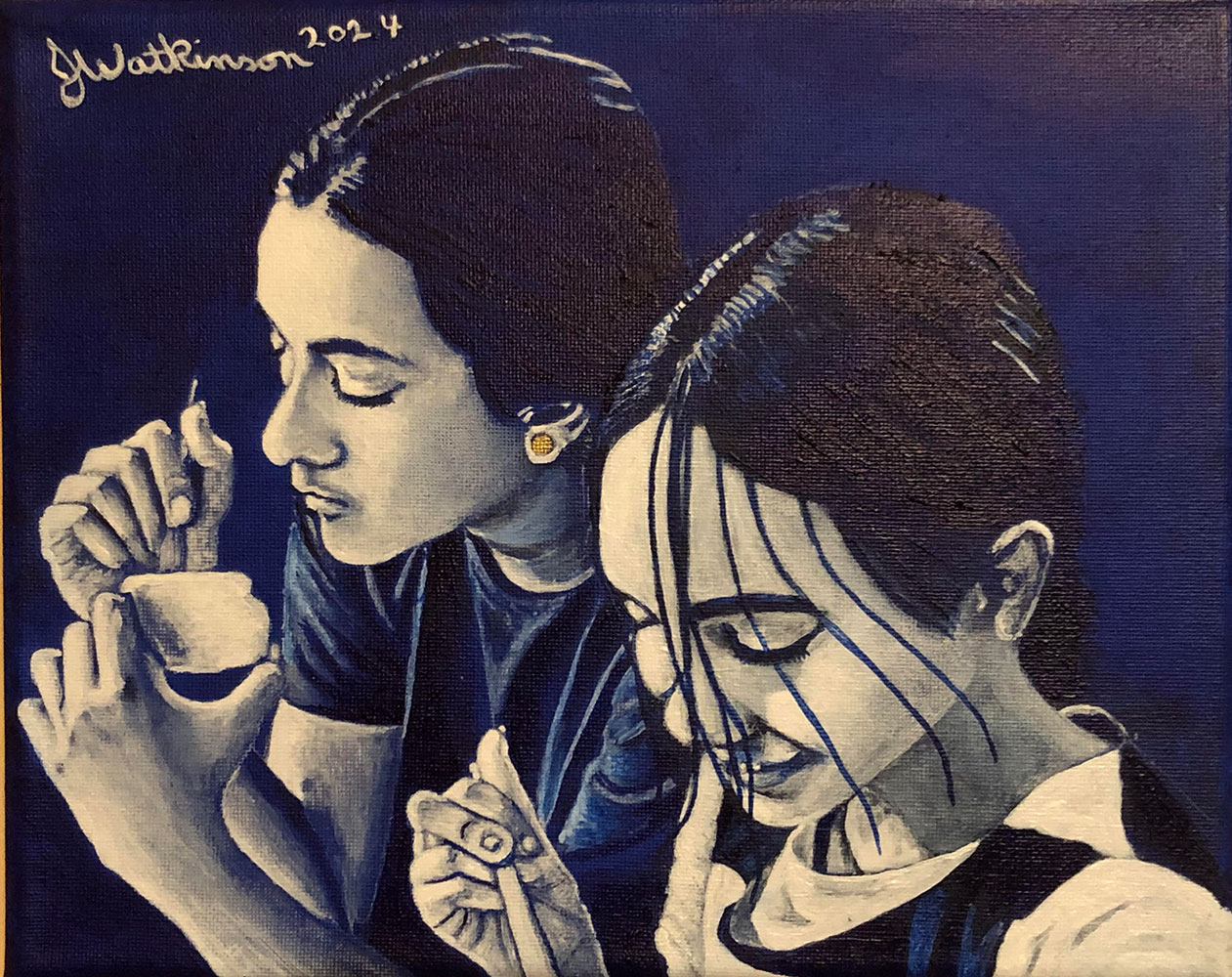
JOHN WATKINSON, UK, 2024, The Lovely Daughters of Shambhu and Sunita
Self-realization and the Source of Inspiration
Shri Mataji Nirmala Devi (Nirmala Srivastava, 1923–2011), the founder of Sahaja Yoga, is known in many capacities: as a spiritual leader of global significance, a guru, a healer, an architect, a writer, and a musician. Yet her greatest contribution — the one for which humanity is especially grateful to her — lies in the field of spiritual growth.
This contribution was the development of a protocol for Self-realization that is accessible to everyone: the collective awakening of Kundalini, the inner maternal energy residing in the sacrum bone at the base of every person’s spine. Through this process, the Kundalini rises to the seventh chakra of the subtle body, the Sahasrara, where the spontaneous union of the individual spirit with the universal Spirit takes place.

MARICHKA VLADYMYR, UKRAINE, 2019, Realization
Thanks to this discovery, every person can attain the long-sought state of moksha (Sanskrit: liberation, the ultimate freedom of the soul), which, according to the Vedic scriptures, is one of the four principal aims of human life. The other three are dharma (righteousness), artha (prosperity and well-being), and kama (the fulfillment of desires and enjoyment). Before the advent of Sahaja Yoga, the attainment of moksha typically required a lengthy process of individual spiritual ascent under the guidance of an experienced guru, often involving many years of renunciation of society and the comforts of civilization. Shri Mataji made Self-realization accessible to everyone, allowing it to be experienced in everyday life, without the need for ascetic practices.
Since 1970, when the protocol of Self-realization was revealed, Shri Mataji devoted several decades to introducing seekers to the knowledge of the subtle system, the qualities of each chakra, and the process of Self-realization through Sahaja Yoga. Whether speaking in renowned venues such as Albert Hall in London or beneath the shade of a spreading tree in a remote Himalayan village, this spiritual teacher and social reformer tirelessly shared this knowledge with all who wished to learn. She organized everything in such a way that, even today, anyone who seeks Self-realization can receive it free of charge in virtually any corner of the world. Remarkably, this achievement even led to Shri Mataji being nominated for the Nobel Peace Prize.
The founder of the system of mass Self-realization was deeply committed to the preservation and promotion of traditional (national) Indian arts and crafts, finding time to discuss artistic masterpieces of the past and present, as well as meaningful interaction with creative individuals. Incidentally, you can already learn more about Shri Mataji’s own artistic achievements on the page dedicated to her contribution to the world’s cultural and artistic heritage.

KONSTANTIN STERKHOV, UK, 2017, Sandra Karuna
The protocol of Self-realization developed by Shri Mataji is universal. Its intended audience is not divided into creative and non-creative seekers, for the capacity for creativity, as well as the ability to appreciate art and its spiritual aesthetics, is inherent in every human being from birth. Yet when Nirmala Devi explained the unique nature of Sahaja Yoga, she often drew examples from the world of art, as it was one of the most accessible and readily understood realms of human experience.
What makes this Self-realization protocol particularly valuable for artists? The answer is simple: it opens the way to inspiration. Creative people are often reluctant to talk about inspiration, fearing that it might disappear if they do. Inspiration is commonly seen as something fleeting and impossible to control. Some even resort to extreme measures in an attempt to induce it artificially with the help of alcohol or other powerful drugs, but such efforts rarely lead to lasting success.
Shri Mataji explained that connection with the realm of inspiration comes in a state of thoughtless awareness, in a state of meditation. Achieving this state is precisely what the Self-realization protocol of Sahaja Yoga offers. This state can be compared to a flute through which the vibrations of music flow, our brain is silent. We are no longer overwhelmed by thoughts about the past or concerns about the future. Instead, we find ourselves in the present moment — the state of being fully “here and now,” a state that is often difficult for people living amid the pressures and distractions of modern life to attain.
Our thoughts, whether about past experiences or future plans, are merely reflections of what we have already learned and accumulated. The founder of this method of Self-realization compared the thinking process to a library filled with books. “Everything that we have thought of have got it or experienced this in the books. Whatever is new coming to us is the inspiration,” she explained. Experience that has already been lived through, understood, and expressed in thoughts belongs to the realm of the known. It leaves little room for spontaneity. “These thoughts are really conditioning on us and they are not inspired things. They are not coming from inside and that’s why we are not spontaneous,” Shri Mataji said. (Shri Mataji Nirmala Devi, 1978-12-18 Agnya Chakra means: To Order, Caxton Hall, London, England)
Meditation in Sahaja Yoga helps practitioners reach this point of inspiration and remain in it for extended periods of time. It is precisely this state of meditation that enables Sahaja artists to create — to perceive the subtlest interplay of light and shadow shaped by the present moment within our awareness and transform it into artistic expression. This is why our website carries the subtitle: Art Created in Meditation.
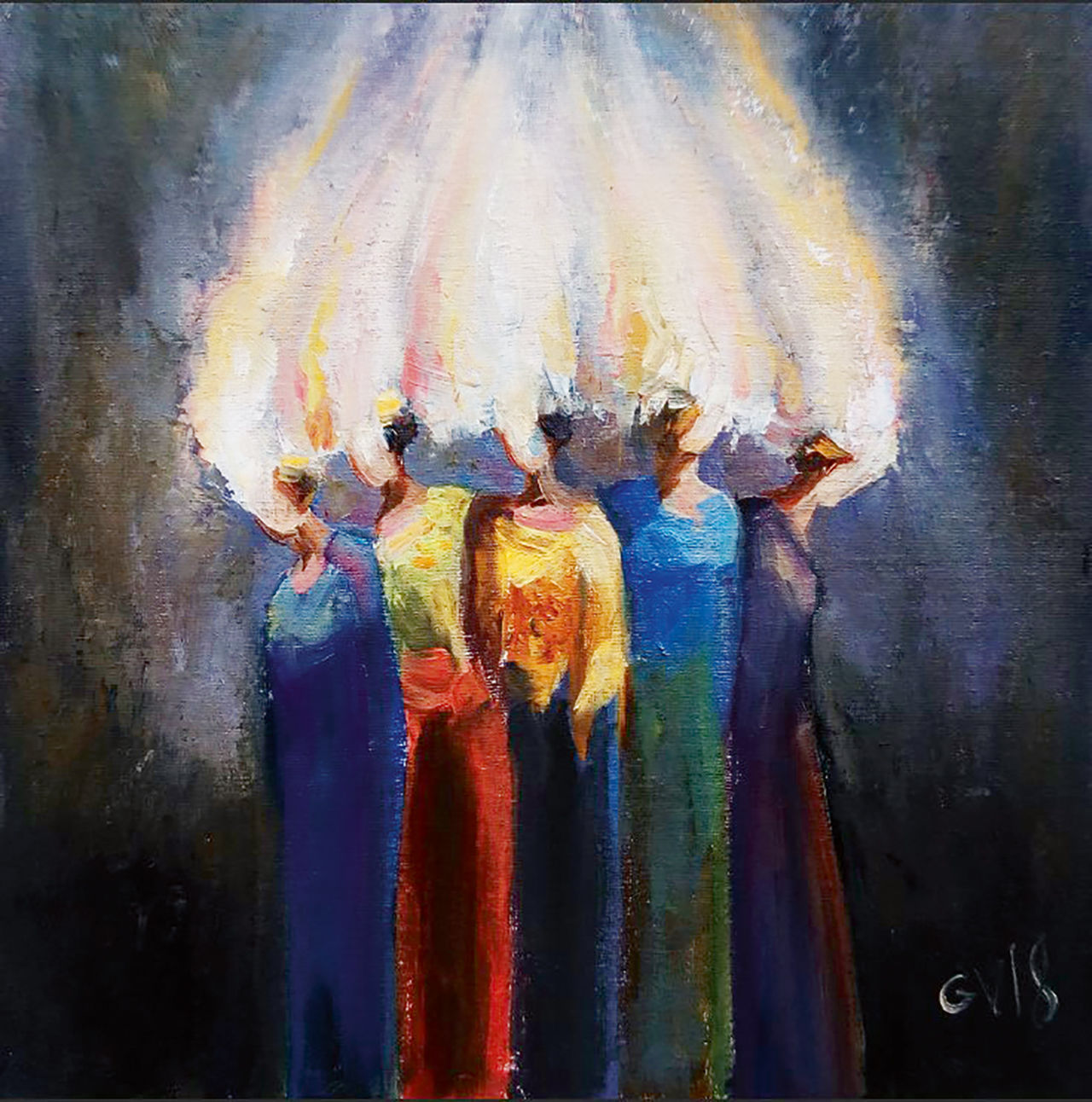
VIRA HORDYNSKA, UKRAINE, 2018, Scales Day
Were there any realized artists before Sahaja Yoga?
Yes, certainly. There were not many of them, yet their voices were heard. Many of them are now regarded as classics. How were they able to reach such a state? After all, none of them renounced the world to become disciples of great sages — the only path to spiritual realization that humanity had traditionally known.
In one of her talks, Shri Mataji Nirmala Devi explained this phenomenon from the perspective of Sahaja Yoga. For those who have only recently begun their journey of self-discovery, let us first briefly recall the three main channels that exist within the subtle system of a human being.
The left channel is cool, lunar, and feminine. It passes through the heart and is often referred to as the channel of emotions and desires. When our attention is predominantly in this channel, we tend to return to the past, reliving experiences and emotions associated with it. This channel is known as Ida Nadi. The right channel is hot, solar, and masculine. We go deep into it when we start planning, analyzing, or thinking about future events. This is Pingala Nadi. The central channel, known as Sushumna Nadi, is the channel of balance and evolution. It is through this channel that our primordial Mother Energy, Kundalini, rises to Sahasrara, the seventh chakra, located above the crown of the head.

JEFF RAUM, USA, 1997, Subtle System
As Shri Mataji explained, if an artist has not attained Self-realization, their creative journey may move either along the right channel — the “hot” channel — or along the left — the “cool” channel. A realized soul, however, chooses the path of the central channel.
If a creative person is excessively engaged in thinking and mental activity, thus functioning through the right channel, their works may become expressions of extreme cruelty. When this approach eventually loses its appeal, they may turn to abstract art. Without Self-realization, however, such works can appear absurd or merely eccentric. Art of this kind is often admired by those whose right side is strongly developed. Such artists may achieve great popularity, but their success is often driven by fashion and trends. When those trends fade, they too are soon forgotten.
If, on the other hand, an artist is primarily absorbed in emotions and moves through the left, or “emotional,” channel, Shri Mataji explained that they may seem to be constantly living through a Greek tragedy — lamenting themselves while encouraging others to do the same.
In time, whether left-sided or right-sided, an artist may grow dissatisfied with this state of affairs. Feeling that they have reached a dead end, they begin to develop a subtler appreciation of creativity, art, literature, and the original sources of wisdom. “He wants to see paintings or he wants to listen to music which sings of Divine or divinity. Whole that madness makes him really think that now we should start doing something better”, — the famous enlightener described the state of an artist trying to reach the truth. (Shri Mataji Nirmala Devi, 1992-02-23 Mahasaraswati Puja Auckland, New Zealand)
If, however, they avoid the pitfalls of religious dogma and do not lose heart, they may eventually arrive at a state in which Self-realization unfolds naturally within them. “If they get realization they become really very dynamic artists, very dynamic writers and people who are creating something of an eternal value,” Shri Mataji said.
In Shri Mataji’s view, such artist “showed both the sides and he showed the right side also”. Among those who remained in the centre, she included her fellow countryman, Rabindranath Tagore. Referring to his example, Shri Mataji explained how the focus of his work gradually evolved and how he himself steadily progressed toward the state of the detached witness:
- So many artists, so many musicians and so many, we can say, writers who have really contributed to the central path of Sushumna because they became realized souls. They were realized souls. Some were born, and some became, and then they completely wrote about the yoga. For example, Rabindranath Tagore, in the beginning, he writes, “How, when will I meet you my friend?” and all that. What you call the separation song… And then after some time, suddenly he gets his realization, because he becomes subtler and subtler and subtler. Then he writes about his meeting, his meeting the Spirit, and he writes about it. So these things work out in such a manner for some people that by their subtleties they arrive at a point of realization.
Shri Mataji Nirmala Devi, 1992-02-23 Mahasaraswati Puja Auckland, New Zealand
The list of great artists whom Shri Mataji regarded as having either consciously chosen the path toward truth through the central channel or having been born in a realized state is quite extensive. In literature, for example, she highlighted Kabir Das, Dante, William Shakespeare, Johann Wolfgang von Goethe, Guy de Maupassant, William Blake, Leo Tolstoy, and Sarat Chandra Chattopadhyay. In the visual arts, she pointed to Leonardo da Vinci, Michelangelo, Raphael, and William Blake. In music, she included Vivaldi, Mozart, Bach, Handel, Beethoven, and Strauss.
To see for ourselves how their works continue to fill the hearts of art lovers with joy — and how the delight they evoke seems capable of lasting indefinitely — we need only turn to them today. Visit an art gallery, a library, or a theatre, and you will not be disappointed. Their artworks remain vibrant, profound, and inspiring. They speak to us as powerfully today as they did in their own time.

MEREDITH COOPER, AUSTRALIA, USA, 2002, Uluru 1
How to determine whether a certain artist is a realized soul?
Art lovers who have never heard of Self-realization and have not experienced it themselves may nevertheless respond in different ways when encountering a work created by a realized soul. Much depends on their inner openness to beauty and to the deeper dimensions of art. Some may feel goosebumps. Others may find themselves momentarily breathless. For still others, an unexpected inner silence may arise — a silence whose nature they cannot fully explain or comprehend.
For those who practise Sahaja Yoga, however, there is little difficulty in recognizing whether an artist is a realized soul. It is enough to direct the palms of the hands toward a work of art. If one feels what is often described as a gentle cool breeze above the palms, this indicates that the artwork was created by a realized artist. The ability to perceive vibrations in this way begins immediately after the experience of Self-realization and becomes stronger through daily meditation
- When you play Mozart, you get vibrations out of it. You can feel them on your fingertips. You can feel them.
Shri Mataji Nirmala Devi 1990-03-19 Media Interview, Canberra, Australia
Shri Mataji often recalled a visit to the Cathedral of Notre-Dame de Paris, where she and a group of Sahaja Yogis felt powerful vibrations. As they approached the choir, the area before the main altar, the vibrations became significantly stronger. The source of these powerful vibrations was located to the right, beneath a large pillar. It turned out to be a fourteenth-century marble statue of the Madonna and Child. Visitors to the cathedral would unconsciously slow their pace and pause before it, if only for a moment. For Shri Mataji, there could be only one explanation: the creator of this masterpiece was undoubtedly a realized soul. Through Self-realization, the artist had been able to transform a shapeless natural material into a work of art that continues to radiate tremendous vibrations. According to Shri Mataji, this same experience can be felt in the presence of the works of all artists who have attained Self-realization and support it with daily meditations.
- Like I would say Mona Lisa’s painting or the Sistine Chapel, if you have seen. You just go there and you look at it and you just don’t think, because it makes you thoughtless. To Sahaja yogis it will. It gives vibrations and you just watch it without thought.
Shri Mataji Nirmala Devi, 1983-09-28 The Blessing of Modern Times, San Francisco, United States
BANAFSHEH DINERZI, IRAN, 2022, 7-Sahastrara
What gives an artist the state of witness?
This state developes gradually, from one meditation to the next. While established in it, you simply observe what is happening within and around you, without translating the experience into words — that is, without thoughts. The state of the witness takes you beyond the drama of life. It allows you to remain detached and balanced, preventing you from being drawn into the extremes of the right and left channels.
Among the great geniuses to whose works Shri Mataji Nirmala Devi often referred, William Shakespeare held a special place. She described him as an avadhuta — a spiritually elevated person who has risen above worldly limitations — and drew upon two of his most famous plays, Romeo and Juliet and Hamlet, to explain how Sahaja Yoga works.
What is it to perceive life as a game?
…An endless stream of tourists moves slowly in a clockwise direction through Juliet’s small courtyard in Verona, Italy. The tragedy of love immortalized by Shakespeare draws millions of visitors to this tiny patch of land. Yet few people think about what Shakespeare meant, because he was certainly talking about something else if he treated the world as a theatrical stage. What was it that went wrong with these young lovers of Verona?
…The audience sits spellbound, watching Hamlet hold the skull of the king’s former jester in his hands. But what is wrong with Hamlet himself? Almost everyone can quote the opening words of his famous soliloquy, “To be or not to be.” Yet after following the masterfully woven twists and turns of this tragedy of revenge, audiences often leave the theatre with little more than an appreciation of the actors’ performance or the production itself.
What, then, was Shakespeare truly seeking to communicate? Shri Mataji Nirmala Devi explained it in the following way:
- And there were many writers in English language you know from Shakespeare you can start who showed the futility of human endeavour like we call an avadhuta, the one who has reached a very great degree of development in his spiritual life. He can see the futility of human endeavour and then he brings them to the point that they have to rise above these stupid and human endeavours and take to some sort of an endeavour, which will bring them something higher and also will create something of an eternal value.
Shri Mataji Nirmala Devi, 1992-02-23 Mahasaraswati Puja Auckland, New Zealand
Depending on the theme of a particular meeting, Shri Mataji would invite her audiences to view the events of these two plays from a specific perspective. For example, when speaking about the witness state, she often described the joy experienced by those who are established in it. A person becomes filled with the joy of being and begins to see the futility of the actions driven by their own ego or by the ego of others. For this reason, Shri Mataji believed that Romeo would have laughed heartily at himself had he attained Self-realization. “Oh, what a fool I was—a complete fool,” he would have said. So much effort, so much drama, and all of it in vain. According to the founder of Sahaja Yoga, the two young lovers of Verona died without ever truly enjoying each other’s companionship.
- Joy is a witness, it’s a kind of a power of a witness which sees a drama, by seeing the drama, whether tragedy or comedy, it’s at a point where it is just a witness and enjoying it. In the same way you’ll see so called comedies and tragedies of your life and the futility of your nonsensical endeavours and you’ll laugh at it, oh that’s it, that’s me.
Shri Mataji Nirmala Devi, 1984-07-08 To Know The Truth, Ilford Town Hall, London
The story of a son driven to revenge by the spirit of his father was, in Shri Mataji’s view, yet another powerful lesson in the futility of human striving and misplaced effort. “Now, how many people who read Hamlet understand this point that the futility of even taking the revenge on his mother or the fellow who killed his father was there? It’s so evident. All those emotions to which we pay so much importance and make it so much identified with your whole life, are nothing but wasteful and futile things, we are wasting our energy”, she thought. (Shri Mataji Nirmala Devi, 1980-09-01 We Have To Get Our Yoga London)
As you watch the play, you become drawn into the action. You imagine yourself in Hamlet’s place or in the position of another character, and you find reasons to justify their actions. Yet you do not become the one who created the work itself — the author whose perspective would allow you to decipher its deeper meaning and central message. The reality, however, is quite different:
- Reality is to finish the drama, to know that it is a drama. We are not part and parcel of that. This is what is the Real state of the mind. Unless and until that is achieved, you are not going to be happy, you are not going to be satisfied, you are not going to be your Self, you are not going to find out your meaning.
Shri Mataji Nirmala Devi, 1980-09-01 We Have To Get Our Yoga, London

GUSTAVO FERNÁNDEZ, ARGENTINA, 2009, Feeling the spirit
Mona Lisa and Christ – access to the truth
The witness state gives the artist another important advantage. While established in this state, the artist perceives what others overlook, gives it form through artistic expression, and places it before the viewer’s gaze, often many years ahead of the era in which they live.
Shri Mataji often expressed her dissatisfaction with the tradition of portraying Jesus Christ as a frail and melancholy figure. How, she would ask rhetorically, could such a man have carried the heavy Cross upon his shoulders? And how could he, in that case, have been the support of the entire world? She greatly admired the work of Michelangelo and was particularly fascinated by The Last Judgment in the Sistine Chapel. One of the reasons for this admiration was the way the great Italian master depicted the Son of God—with the physique of someone accustomed to great physical endurance and effort.
Another unconventional perspective on a work of art is associated with the name of the great Renaissance master Leonardo da Vinci. The founder of the method of Self-realization always placed special emphasis on an artist’s reverence for the principle of purity, particularly as expressed through the bond between mother and child. In this regard, Shri Mataji believed that the mystery behind the smile of the woman portrayed in Leonardo’s celebrated Mona Lisa was not difficult to explain. She was particularly fond of a legend according to which Signora Gioconda had lost a child shortly before the painting sessions began and was therefore deeply saddened. During one of the portrait sessions, a small child was brought into the room, and a smile appeared on her face. It was this gentle and tender radiance, Shri Mataji suggested, that Leonardo captured on canvas.
- After Realization you become the absolute. There is no relative value, you do not judge anything relatively, you just know what is absolute and once you know the absolute you are cocksure about it, there’s no wavering. Thus you become an extremely powerful person, and you know the truth about everything.
Shri Mataji Nirmala Devi, 1985-05-30 Enjoying The Joy, San Diego, United States

SNEHLATA KUSHWAHA, INDIA, 2022, Mandala art Krishna & Cow
Is it possible to create works of art during meditation?
As it turns out, it can. The artworks presented in our digital gallery demonstrate that, for an artist, the state of meditation can be dynamic. Remaining in a state of inner balance clears away accumulated fears and limitations, opening the way for that unique inner melody which guides the artist toward the creation of beautiful forms and images.
The founder of Sahaja Yoga described this process in the following way:
- Your mind is jumping either on the past or on the future. But the Kundalini is the only thing that stops you at present moment so that you don’t consider the past and the future but you enjoy the present, the complete dynamism of the present and you are effective. You are dynamic. You can do thousand and one thing, which normally you cannot do and you are surprised how it works out.
Shri Mataji Nirmala Devi, 1985-05-30 Enjoying The Joy, San Diego, United States
You become like a flute in the hands of the Divine, allowing its message to flow through you.
- A very good simile is given like a hollow flute. You become the hollow flute through which the melody flows. And others say that it is you who is playing but actually you see the melody flowing and enjoying it. You become that.
Shri Mataji Nirmala Devi, 1980-06-06 Why Are We Here, London

GISELE MOURA, BRAZIL, 2022, Playing world
Music opens your inner space
Music is an integral part of Sahaja Yoga. It resonates in the morning mantra, accompanies collective meditations, and opens the hearts of seekers. If you know any Sahaja Yogis, you have probably noticed their habit of quietly humming a tune to themselves. It often seems as though the very atmosphere around them is filled with melodies and rhythms that simply have to find expression.
It is therefore no surprise that music is also woven throughout our website — and not only in the section dedicated to Sahaja musicians. One can almost hear it in the compositions of the paintings, in the harmony of colours and patterns found in the embroidery, and in the eloquent silence of the sculptures.
Naturally, this refers first and foremost to Indian classical music. According to Shri Mataji, it has a profound influence on the subtle aspects of human nature and possesses the ability to inspire and nourish a person at different moments of life, in different seasons of the year, and at different times of the day. She described it as an extraordinarily scientific system and encouraged people to study it in order to establish balance within themselves and help bring balance to others. In her view, this musical tradition reflects the movement of the Kundalini from one swara (musical note) to another, each corresponding to a particular chakra within the subtle system. She also maintained that this music is divine in its nature.
Expanding on Shri Mataji’s observations, the renowned Indian musician and Sahaja Yogi Arun Apte described the influence of Indian classical music on the human subtle system in the following way:
- The awakening of the Kundalini in Sahaja Yoga takes place through the touch of musical notes. The notes touch the chakras, and the Kundalini awakens. The Kundalini reaches the Sahasrara through the Sushumna (the central channel) and through all the chakras. Then the Kundalini becomes one with God. Vibrations begin to flow, yogis enter Nirananda (the state of pure joy), and the seeker begins the journey along the path of evolution”. (“Music & Sahajyoga”)
It is therefore not surprising that, when it comes to establishing a genuine connection with the energy of the Universe, it matters greatly who performs this music:
- Devotional music if it’s sung by people who are realized souls reaches your heart reaches your kundalini also and helps a lot to awaken them.
Shri Mataji Nirmala Devi, 1990-03-19 Media Interview, Canberra, Australia

BHASKAR SUBRAMANIAN, INDIA Ab toh Jaago Raag Ahir Bhairav
Meditation helps Sahaja Yogis not only attune themselves before a musical performance, but also choose the piece that is to be presented to an audience. While the role of Indian classical music may be clear, what about Western classical music or contemporary compositions being created today?
Shri Mataji advised yogis to be guided by the presence of vibrations:
- Now, after Realization you see, then you will be able to decide exactly whether it is aesthetically correct or not. If it is correct, it will be vibrating. Like, we’ll say Mozart. Now, to you, Mozart or anybody else is just the same. To Me, Mozart is great because as soon as you play his music, vibrations start flowing.
Shri Mataji Nirmala Devi, 1978-11-20 How to approach Sahaja Yoga, Caxton Hall, London, England
This approach enables the contemporary musical tradition of Sahaja Yoga to develop in a rich and comprehensive way. It draws upon the best that different cultures and different ages have to offer, and this harmonious synthesis helps awaken a profound and all-pervading sense of joy.

POLLYANNA RODRIGUES, BRAZIL Água de Estrellas
…The Borbera Valley in northern Italy is renowned for its festivals. Each of them has its own distinctive character, yet only one offers visitors the opportunity to experience vibrational spiritual music. This is the traditional Sahaj festival, Culture of the Spirit , founded by the “principessa dall’India”, as Shri Mataji is affectionately known to many Italians. The festival takes place in Cabella Ligure, at the heart of this place. Every summer, Sahaja Yogi musicians from around the world gather here to spend a week together. Forming a symphony orchestra in a spontaneous way, they prepare and perform an ambitious musical programme that brings together Eastern and Western traditions.
During the festival, the vibrational atmosphere reaches extraordinary heights, and bubbles of joy seem to drift to every corner of the world.

EMANUELE “RayHeart Visual”, Italy, On Stage
Joy is beyond duality
So, let us return to the theme of joy.
If you enter this word into the search bar on our website, you will find only a handful of artworks whose titles contain it. Yet as you move from page to page through our digital gallery, even where the word itself is absent, you may notice that a smile lingers on your face.
That is precisely the point: the artworks gathered under this virtual roof are infused with joy. Their creators have been practising meditation for many years and generously share their awareness of the beauty of this state through their art.
- The third thing that happens to you apart from your awareness becoming the truth, the complete knowledge, you become the source of joy, not that you only receive the joy but you become the source of joy, the source of bliss and the source of peace. Wherever such a person goes, it just soothes.
Shri Mataji Nirmala Devi, 1985-05-30 Enjoying The Joy, San Diego, United States
When inner balance becomes established within a person, joy naturally arises, and one feels compelled to share it generously with others, just as the contributors to our artistic platform do. Shri Mataji repeatedly emphasized the importance of attaining this state. She spoke of the unique nature of joy and of its freedom from duality.
- Joy is an absolute quality, it’s not a duality, like happiness and unhappiness. When your ego is pampered, you feel happy, when it is not pampered then you’re hurt then you suffer and you feel unhappy. But joy is a state where you become a witness – you are neither happy nor unhappy – in a perfect joyous state. And you just laugh at everything that is stupid. And you don’t get disturbed by somebody who tries to intimidate you. You stand in your own glorious spirituality.
Shri Mataji Nirmala Devi, 1986-05-23 The Spirit Is The Light, Madrid Spain
Perhaps you will agree that this is a good reason to experience Sahaja Yoga meditation for yourself, just as our artists have done. We hope this article has offered you a glimpse into the boundless source of inspiration behind their creations and helped explain why our artists choose to work from the state of witness awareness.
If your heart rejoices while exploring the artworks featured on our website, you are welcome to connect directly with their creators by writing to the email address listed on each artist’s personal page . You may also purchase a work that resonates with you. In doing so, you will support an artist whose work you value and fill your home or workplace with the pure vibrations of spiritual growth.
If, on the other hand, your interest has been awakened by Sahaja Yoga itself as a path to inner balance, you can contact any of our meditation centres or join one of the online platforms where meditation sessions are held on a regular basis.
We invite you to become part of our space of vibrations of joy and harmony!

SWANTRIBUNE, GERMANY, 2019, A Maharaj, one rather larger to borrow me rubies as large as pomegranates